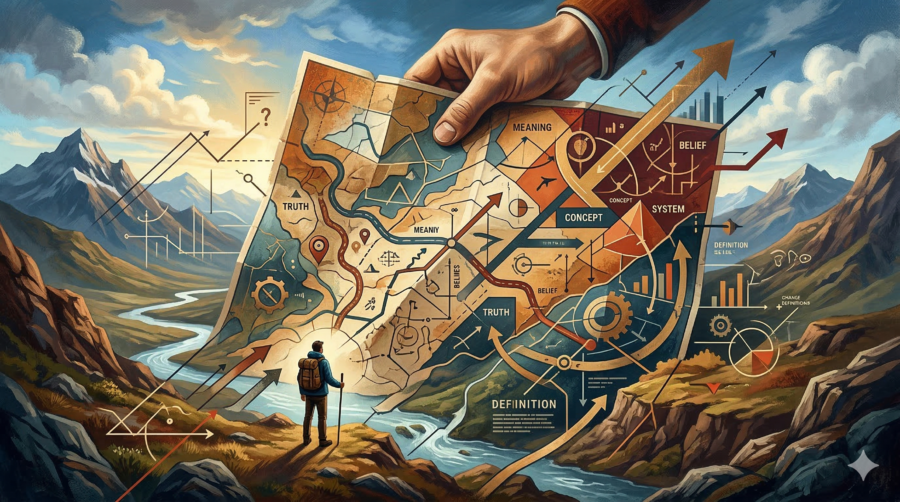
Why do we so often take stories literally, forgetting that they are not historical records but maps of our inner world? Metaphors are not failed attempts at factual description—they are precise instruments pointing to truths beyond the reach of facts. When ancient texts speak of gods, demons, and celestial realms, they are speaking about states of consciousness, the theater of the mind, the eternal drama unfolding not in a distant afterlife but in the space between your thoughts, here and now.
Why do we forget that metaphors and stories are for different states of mind? The same narrative means one thing when you are suffering and another when you are content, one thing when you are young and another when you are old. Read literally by a mind seeking certainty, a story offers simple rules; read symbolically by a mind comfortable with ambiguity, it unveils deeper teachings. These stories were designed to work on multiple levels at once: to give the child a tale of heroes and monsters, to give the adult a guide to self-integration, to offer the literal-minded a rulebook, and the contemplative a framework for transcendence.
In the Puranas there are countless stories that contradict each other, Shiva appears in one tale as the ascetic destroyer and in another as the householder husband, Vishnu takes different forms for different purposes, the same god behaves differently in different contexts, and this is not sloppy editing, this is not evidence that the compilers didn’t notice the inconsistencies, this is the entire point, the god is not a person with a fixed personality, the god is a principle that manifests differently depending on what the situation requires, Shiva is both the destroyer and the regenerator because destruction and regeneration are not opposites but phases of the same cycle, aspects of the same process, and you need both aspects in your own consciousness depending on what needs to die and what needs to be reborn.
The Mahabharata does not give you clear heroes and villains, it gives you complicated humans doing terrible things for comprehensible reasons, the Pandavas who win the war are not morally superior to the Kauravas who lose it, both sides violate dharma, both sides use deceit, both sides cause suffering, and this is not a flaw in the storytelling, this is what the story is teaching you, that righteousness is contextual, that moral clarity is an illusion, that every choice involves compromise, that the warrior on the battlefield facing an impossible decision between loyalty to family and loyalty to justice is you, every day, in every choice where your competing duties pull in opposite directions.
But we literalized it, we needed to know which side was right, we needed clear categories of good and evil, we needed to turn the deliberately ambiguous teaching into a simple narrative of heroes defeating villains so we could know which team to join, which identity to adopt, who to emulate and who to condemn, and in doing this we lost the entire teaching, we traded the profound psychological insight for the comfortable moral certainty, we got to feel righteous but we stopped growing.
When the Buddha speaks of Mara appearing during his meditation, when he describes the temptations offered, the doubts raised, the fears amplified, he is not describing an encounter with a literal demon, he is describing what every person who has ever tried to transform themselves encounters, the inner voice that says you’re not ready, you’re not worthy, you should wait, you should settle for less, you should give up before you fail, this voice uses different masks at different times, sometimes it appears as doubt, sometimes as desire, sometimes as fear, sometimes as grandiosity, but it’s always the same force, the part of you that prefers familiar suffering to unfamiliar freedom, and recognizing this force, naming it, refusing its offers, that is the work, that is what the story is teaching, but only if you understand it’s about you, only if you stop looking for the historical demon and start looking for the psychological pattern.
Jesus in the wilderness fasting for forty days while Satan offers him bread and power and certainty is the same story, different cultural clothing, same essential teaching, when you are in the wilderness of transformation, when you are between your old self and your new self, when you are vulnerable and uncertain and stripped of your usual defenses, that is precisely when the easy paths appear, the shortcuts, the compromises, the offers to skip the difficult work and jump straight to the reward, and the spiritual victory is not in being strong enough to never hear these offers but in hearing them clearly and refusing them anyway, in recognizing that the easy path leads nowhere worth going, but we made it about a supernatural being testing a supernatural savior and missed the fact that the test happens to everyone, that every human in transition faces these exact temptations wearing different costumes.
The Garden of Eden, the snake, the fruit, the exile, this is not ancient history this is this morning, this is every morning, this is the structure of human consciousness itself, we are the animals who became aware, who ate from the tree of knowledge of good and evil and cannot go back to innocence, we are the species that knows we will die, that can imagine alternatives to what is, that must choose between competing values, that bears the burden of moral agency, and with that knowledge came shame and guilt and the sense of separation from nature, came the need for clothing and work and all the structures we build to manage the terror of being conscious in an indifferent universe, the story is not about something that happened once to two people in a garden, it is about what happens continuously to every human being born into awareness, but we had to literalize it, had to place it on a timeline, had to argue about whether the snake had legs before God cursed it, as if any of that matters, as if the power of the teaching depends on the logistics of reptile anatomy.
In the Ramayana, Ravana the demon king is not just evil, he is a great scholar, a devotee of Shiva, a capable ruler, he has all the qualities we admire, intelligence, dedication, power, and he still falls because of one flaw, because desire overrides wisdom, because knowing what is right is not the same as doing what is right, and this complexity is what makes the story powerful, Ravana is not other, Ravana is us when we let one appetite overwhelm all our other values, when we know better and do wrong anyway, when we justify the unjustifiable because we want something badly enough, but we simplified it, we made him merely evil, we turned him into a category we could reject rather than a mirror we must recognize, and in doing so we lost the warning, we lost the teaching about how good people become monsters one rationalization at a time.
Why do we do this, why do we consistently choose literal interpretation over metaphorical depth, and the answer is that literalism is easier, literalism requires less from us, if the story is about historical events then all you need to do is believe it happened or didn’t happen, accept it or reject it, memorize it and repeat it, but if the story is about patterns in consciousness then you have to do the work of recognizing those patterns in yourself, you have to admit that the demon is not out there but in here, that the god is not watching from above but emerging from within, that the battle is not between groups but between aspects of your own mind, and this is harder, this requires constant vigilance, constant self-examination, constant willingness to see what you would rather not see.
And institutions benefit from literalism, religious authorities need the stories to be literal because literal stories require gatekeepers, require official interpreters who can tell you what the text means, what you are supposed to believe, how you are supposed to behave, whereas metaphorical stories are dangerous to institutional power because anyone can engage with a metaphor, anyone can find their own meaning, anyone can apply the pattern to their own circumstances without needing permission from authorities, a living metaphor threatens hierarchy in ways that dead history never does.
In the image you sent me, the angel and the devil are holding hands, and someone asks do they know we are metaphors for different mental states of being, and the devil says I hope so, because if they know then the teaching survives, then the wisdom remains accessible, but if they insist we are literal beings then they have lost access to the teaching entirely, they are defending boundaries that don’t exist, fighting wars over which metaphor is the right metaphor, building walls with bricks made from texts that were teaching them to see past walls.
The Bhagavad Gita places its teaching on a battlefield not because the historical battle matters but because the battlefield is the perfect metaphor for life itself, you are always on a battlefield, always facing competing duties, always forced to act even when the right action is unclear, always surrounded by people you love who are nevertheless your opponents in this moment, always torn between withdrawal and engagement, between following rules and breaking them when circumstances demand, Krishna is not giving Arjuna military tactics, Krishna is giving all of us a framework for understanding action and duty and consequence and the relationship between individual will and cosmic order, but if you get stuck on whether the battle actually happened you have missed the entire teaching, you are reading a instruction manual for consciousness as if it were a history book.
The characters can change, the details can shift, the gods can wear different names and different faces in different cultures, Indra and Zeus both throw thunderbolts because both are teaching about power and authority and the forces of nature that dwarf human concerns, Yama and Hades both rule underworlds because both are teaching about death and judgment and the reckoning that comes at the end, the same patterns appear everywhere because human consciousness works the same way everywhere, the architecture of the mind is not culturally specific even though the symbols we use to describe it are, and the stories travel precisely because they are not tied to specific historical events, they are teaching about universal patterns, eternal recurrences, the things that remain true across time and place because they are true about the structure of being human.
But we insist on uniqueness, we insist that our story is different, that our revelation is special, that our prophet is the only real prophet, that our text is the only literal truth while everyone else’s texts are just mythology, and this insistence on exclusive literalism is what generates religious conflict, because if my story is literally true then yours must be literally false, we cannot both be right if we are making historical claims, but if we are both using metaphors to point at the same underlying realities then there is no conflict, there is only different languages for describing similar insights, different cultural technologies for encoding wisdom, and we can learn from each other’s metaphors without needing to abandon our own.
The essence should be preserved, this is what matters, not the exact words but the insight behind the words, not the specific ritual but the transformation the ritual is meant to facilitate, not the historical accuracy of the narrative but the psychological truth it conveys, and preserving essence requires flexibility, requires the willingness to adapt form while maintaining function, requires the courage to let the surface change so the depth can remain accessible, but instead we cling to the surface and let the depth escape, we memorize scriptures without understanding them, we perform rituals without experiencing their purpose, we defend the letter while the spirit evacuates.
The angel and the devil are not separate beings, they are two poles of a single consciousness, you cannot have transcendence without gravity to transcend, cannot have the reaching upward without the weight pulling down, cannot have the aspiration toward meaning without the despair of meaninglessness, they hold hands because they are partners in the generation of your experience, and the spiritual work is not to destroy one and crown the other but to hold both, to acknowledge both, to see that the tension between them is what generates the energy of consciousness itself, but this teaching is too subtle for literal minds, literal minds need enemies to fight, need absolute good and absolute evil, need heaven as reward and hell as punishment, need the universe to be a simple battle with clear sides.
Why do we forget that metaphors are for different mental states of being, because remembering requires effort, requires the willingness to live in complexity, requires accepting that truth operates at multiple levels simultaneously, that the same story can be true as metaphor while false as history, that wisdom transcends the question of whether events actually occurred, that the goal is not to believe the right things but to become transformed by engagement with teachings that point beyond themselves toward something that cannot be captured in literal language, and most of us are not willing to do this work, most of us prefer the comfort of certainty even when that certainty closes us off from transformation, even when that certainty turns living wisdom into dead dogma, even when that certainty makes us defenders of forms that no longer serve their function. So the metaphor becomes literal, the teaching becomes doctrine, the story becomes history, the living symbol becomes dead fact, and we wonder why the wisdom no longer works, why the stories no longer transform us, why we can follow all the rules and perform all the rituals and believe all the right things and still feel empty, still feel lost, still feel like something essential is missing, and what is missing is the metaphorical consciousness, the ability to read symbols, the willingness to see that the kingdom of heaven is not a location but a state of mind, that the demon is not a being but a pattern, that the god is not a person but a principle, that everything the stories are teaching is about you, right now, in this moment, and will remain about you until you die, and the only question is whether you will engage with them as living teachings or defend them as dead facts.